In short
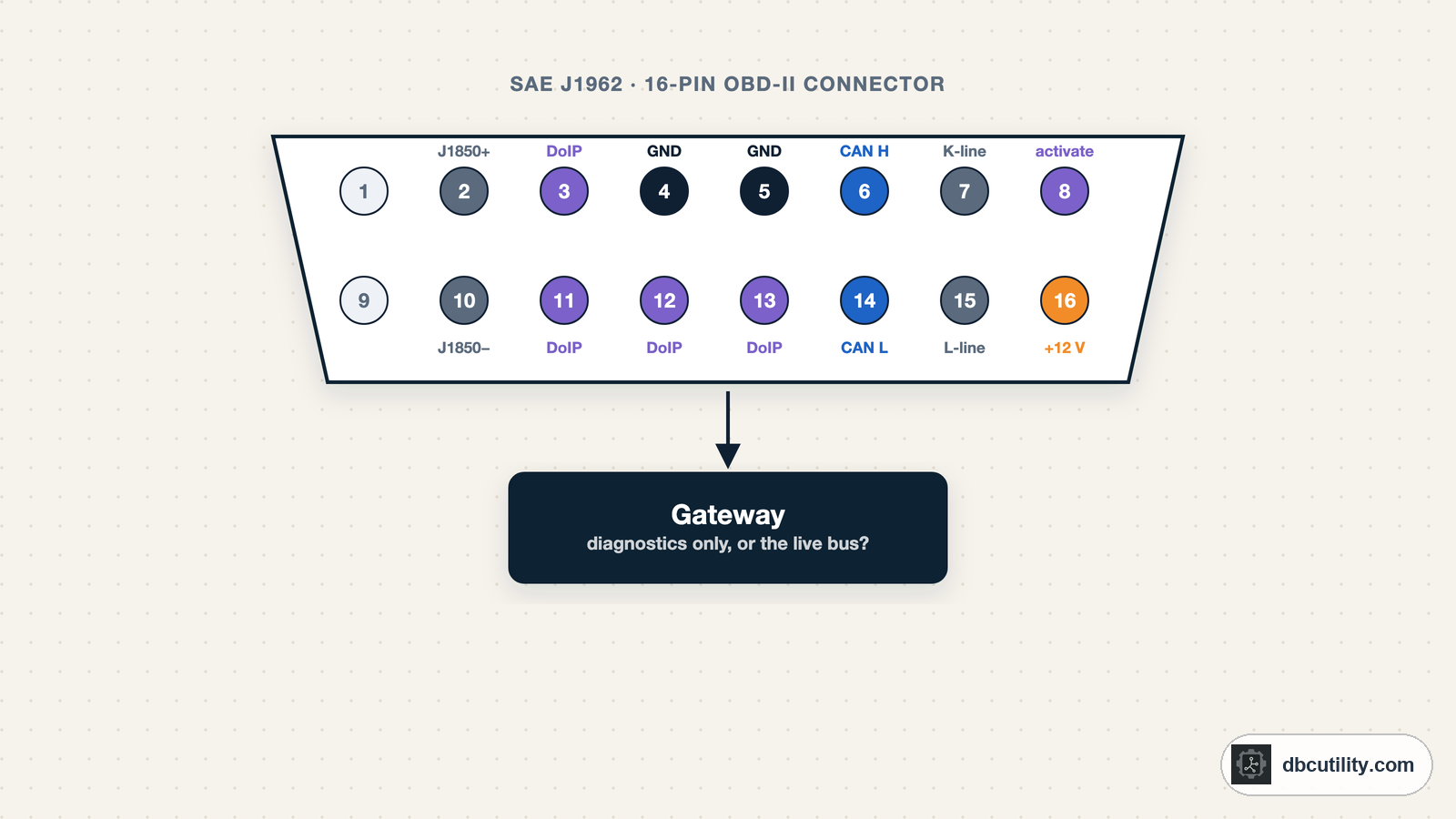
CAN high and low are on pins 6 and 14, power on 16 and grounds on 4 and 5. Whether you see the vehicle's own traffic there depends on the gateway: some cars put a live bus on the port, many only answer diagnostic requests. A quiet port that answers 01 00 is a gateway, not a fault.
Best for: Engineers and makers connecting a CAN interface or logger to a vehicle's OBD-II port for the first time
The OBD-II port is the first place everyone plugs into, and the first place many get stuck: the interface is connected, the bitrate is right, and nothing arrives. Usually nothing is broken. The port is wired to a gateway that only speaks when spoken to. This guide covers what is on each pin, what the gateway does, and how to reach the traffic you actually want.
The pinout
The connector is defined by SAE J1962. The pins that matter:
| Pin | Signal | Used by |
|---|---|---|
| 4 | Chassis ground | All |
| 5 | Signal ground | All |
| 6 | CAN high | ISO 15765-4, SAE J2284 |
| 14 | CAN low | ISO 15765-4, SAE J2284 |
| 7 | K-line | ISO 9141-2, ISO 14230-4 (KWP2000) |
| 15 | L-line | ISO 9141-2, ISO 14230-4 |
| 2 | Bus positive | SAE J1850 PWM and VPW |
| 10 | Bus negative | SAE J1850 PWM |
| 16 | Battery voltage | +12 V (type A connector) or +24 V (type B) |
OBD-II became mandatory for US passenger cars in 1996, and EOBD in the EU for petrol cars from 2001 and diesels from 2004. Since 2008, all cars sold in the US have had to use CAN (ISO 15765-4) for OBD-II. On older cars you will find K-line or J1850 instead, which a CAN interface cannot read.
The remaining pins are left to the manufacturer. Some vehicles put a second CAN bus on them, and vehicles with DoIP use them for Ethernet: the common layout puts one pair on pins 3 and 11, the other on 12 and 13, and an activation line on pin 8. The DoIP guide explains how to use them.
Two cautions before connecting anything:
- Pin 16 is connected to the battery. A short to a signal pin can damage your interface or the vehicle's wiring.
- A 24 V type B connector on a truck must not get a 12 V-only device.
Live bus or diagnostic port?
What appears on pins 6 and 14 depends on how the manufacturer wired them:
| What you see | What it means |
|---|---|
| Hundreds or thousands of frames per second, many IDs, with no request | The port is connected to a live bus, often powertrain CAN |
Nothing, until you send an OBD-II request, then answers from 0x7E8 and up | The port is behind a gateway that passes diagnostics only |
| Nothing, and no answer to requests | Wrong bitrate, ignition off, a non-CAN vehicle, or wiring |
Separating the vehicle's internal buses from the port is meant to protect them: a faulty or malicious device on the port should not be able to flood the bus the brakes use. A central gateway routes diagnostic requests to the right internal bus and passes the answers back, and drops everything else.
This check tells you which case you have:
import time

import can


def what_is_on_the_port(bus, listen=3.0):
    """Listen first; if the port is quiet, ask for OBD-II PID 0x00 and see who answers."""
    seen = set()
    end = time.monotonic() + listen
    while (remaining := end - time.monotonic()) > 0:
        msg = bus.recv(remaining)
        if msg is not None:
            seen.add(msg.arbitration_id)
    if len(seen) > 5:
        return f"{len(seen)} IDs without asking: the port carries a live bus"
    bus.send(can.Message(arbitration_id=0x7DF, is_extended_id=False, data=[0x02, 0x01, 0x00, 0, 0, 0, 0, 0]))
    end = time.monotonic() + 0.5
    while (remaining := end - time.monotonic()) > 0:
        msg = bus.recv(remaining)
        if msg is not None and 0x7E8 <= msg.arbitration_id <= 0x7EF:
            return f"quiet until asked; ECU at 0x{msg.arbitration_id:X} answers: diagnostics through a gateway"
    return "no traffic and no OBD-II answer: check bitrate, ignition and pins"


with can.Bus(interface="socketcan", channel="can0") as bus:
    print(what_is_on_the_port(bus))
Tested against a simulated bus, it reports a live bus when ten periodic IDs are present without a request, and a gateway when the bus is silent until 01 00 gets an answer from 0x7E8.
Secure gateways
Some manufacturers go further and authenticate the tester. FCA (now Stellantis) vehicles from model year 2018 have a security gateway module: aftermarket tools can still read trouble codes, the VIN and live data, but clearing codes and running active tests need an authorised tool. Other manufacturers have introduced similar gateways since.
For reverse engineering this means:
- Read-only diagnostics usually still work: OBD-II PIDs and many UDS reads, as in the OBD-II PIDs guide.
- Writes, routines and resets may be refused with a negative response or no answer at all.
- The vehicle's internal traffic never reaches the port.
Reaching the bus behind the gateway
When you need broadcast signals, such as steering angle or door states, you have to connect where they travel:
- At an ECU connector or the gateway's own connector. In many architectures the buses meet at the gateway, so its connector can be the one place where all of them can be reached. Wiring diagrams show which pins carry which bus.
- On the harness, with a T-adapter for the connector or a contactless CAN reader that clamps around the twisted pair and picks up the signal without cutting insulation.
- At the OBD-II port of a vehicle that has a live bus there, if you are free to choose the test vehicle.
To identify a CAN pair on a harness: it is a twisted pair; with the vehicle off and the bus terminated, you measure about 60 Ω between the two wires; with the bus idle, both wires sit near 2.5 V, and when traffic runs, the high wire rises toward about 3.5 V and the low wire falls toward 1.5 V. Connect listen-only first. An interface that transmits error frames at the wrong bitrate disturbs every ECU on that bus.
Frequently asked questions
Which OBD-II pins are CAN?
Pin 6 is CAN high and pin 14 is CAN low, as defined by SAE J1962 and used by ISO 15765-4. Pins 4 and 5 are ground and pin 16 is battery voltage.
Why does my CAN interface see nothing on the OBD-II port?
The port is often connected to a gateway that only forwards diagnostic messages. Send an OBD-II request such as 01 00 to 0x7DF; if an ECU answers, the connection works and the gateway is filtering the rest. Otherwise check the bitrate, the ignition and the pins.
What is a secure gateway module?
A gateway that authenticates diagnostic tools before allowing certain functions. On FCA and Stellantis vehicles from 2018, unauthorised tools can read codes and live data, but clearing codes and running tests requires an authorised tool.
Can I read CAN data behind the gateway?
Yes, by connecting directly to the bus you need: at an ECU or gateway connector, with a harness adapter, or with a contactless CAN reader. Use listen-only mode until you are sure of the bitrate.
References
DBC Utility
One desktop app for DBC files and CAN recordings.
One-time $34 · Windows & Linux · Files stay on your computer