In short
Ask PID 0x00 first. Its 4-byte bitmap says which of the next 32 PIDs the ECU supports, and the last bit says whether to ask PID 0x20 next. Decode values with the standard formulas, read DTCs with service 03 and the VIN with service 09.
Best for: Engineers and makers reading live data, trouble codes or the VIN from a car's OBD-II port
Sending 01 0C to a car and getting engine speed back is the easy part. The OBD-II request example covers that. The next questions are harder: which of the standard PIDs does this car actually answer, what do the bytes mean, where are the trouble codes, and how do you get a VIN that does not fit in one CAN frame?
This guide answers those with real frame layouts and a Python scanner you can run on a SocketCAN interface.
The request and response in one table
Everything below uses 11-bit CAN IDs from ISO 15765-4:
| Item | Value |
|---|---|
| Functional request (every OBD ECU listens) | 0x7DF |
| Physical request to one ECU | 0x7E0–0x7E7 |
| Responses | 0x7E8–0x7EF, the ECU's request ID + 8 |
| Byte 0 of a single frame | Number of bytes that follow |
| Positive response | Service + 0x40, so 01 → 41, 03 → 43, 09 → 49 |
| Negative response | 7F, the service, then a reason code |
The services you will use most:
| Service | Purpose |
|---|---|
01 | Current data |
02 | Freeze frame data |
03 | Stored trouble codes |
04 | Clear trouble codes and stored values |
07 | Pending trouble codes |
09 | Vehicle information, such as the VIN |
0A | Permanent trouble codes |
Ask which PIDs the car supports
Do not guess PIDs. Send PID 0x00:
7DF  [8]  02 01 00 00 00 00 00 00     request: 2 bytes, service 01, PID 00
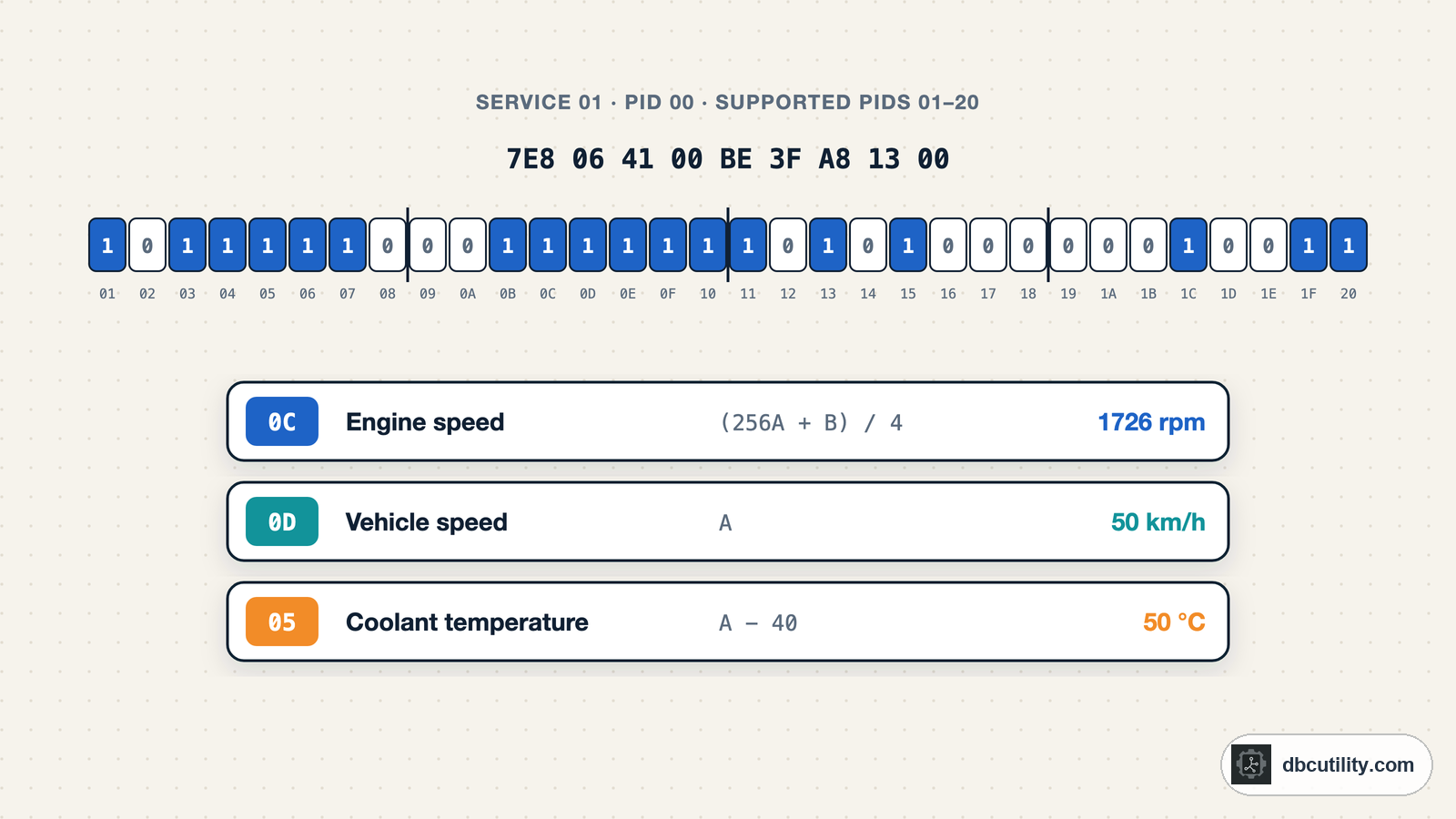
7E8  [8]  06 41 00 BE 3F A8 13 00     answer from the engine ECU
The four bytes after 41 00 are a bitmap. Each bit, from the most significant bit of the first byte to the least significant bit of the last, says whether one of the next 32 PIDs is supported.
| Byte | Hex | Binary | PIDs |
|---|---|---|---|
| A | BE | 1011 1110 | 01–08: 01, 03, 04, 05, 06, 07 |
| B | 3F | 0011 1111 | 09–10: 0B, 0C, 0D, 0E, 0F, 10 |
| C | A8 | 1010 1000 | 11–18: 11, 13, 15 |
| D | 13 | 0001 0011 | 19–20: 1C, 1F, 20 |
The last bit is PID 0x20. It does not carry data; it says the ECU also answers PID 0x20, which is the bitmap for PIDs 21–40. Keep asking 0x20, 0x40, 0x60 and so on until that last bit is 0.
More than one ECU can answer a functional request. An engine ECU replies from 0x7E8, a transmission ECU often from 0x7E9, and each sends its own bitmap. To talk to one of them only, send to its physical ID: 0x7E0 for the ECU that answers from 0x7E8.
Decode the common PIDs
A is the first data byte after the PID and B the second. These formulas are the SAE J1979 definitions as listed in the OBD-II PIDs reference:
| PID | Name | Formula | Unit |
|---|---|---|---|
04 | Calculated engine load | A × 100 / 255 | % |
05 | Engine coolant temperature | A − 40 | °C |
0B | Intake manifold absolute pressure | A | kPa |
0C | Engine speed | (256 × A + B) / 4 | rpm |
0D | Vehicle speed | A | km/h |
0F | Intake air temperature | A − 40 | °C |
10 | Mass air flow | (256 × A + B) / 100 | g/s |
11 | Throttle position | A × 100 / 255 | % |
1F | Run time since engine start | 256 × A + B | s |
21 | Distance travelled with MIL on | 256 × A + B | km |
2F | Fuel tank level | A × 100 / 255 | % |
31 | Distance since codes cleared | 256 × A + B | km |
42 | Control module voltage | (256 × A + B) / 1000 | V |
46 | Ambient air temperature | A − 40 | °C |
5C | Engine oil temperature | A − 40 | °C |
5E | Engine fuel rate | (256 × A + B) / 20 | L/h |
For example, 41 0C 1A F8 is (256 × 26 + 248) / 4 = 1726 rpm.
A Python scanner
These functions decode bitmaps, values and trouble codes. They need no CAN hardware:
SERVICE_01 = {
    0x04: ("Calculated engine load", "%", lambda a, b: a * 100 / 255),
    0x05: ("Engine coolant temperature", "°C", lambda a, b: a - 40),
    0x0B: ("Intake manifold pressure", "kPa", lambda a, b: a),
    0x0C: ("Engine speed", "rpm", lambda a, b: (256 * a + b) / 4),
    0x0D: ("Vehicle speed", "km/h", lambda a, b: a),
    0x0F: ("Intake air temperature", "°C", lambda a, b: a - 40),
    0x10: ("Mass air flow", "g/s", lambda a, b: (256 * a + b) / 100),
    0x11: ("Throttle position", "%", lambda a, b: a * 100 / 255),
    0x1F: ("Run time since engine start", "s", lambda a, b: 256 * a + b),
    0x21: ("Distance with MIL on", "km", lambda a, b: 256 * a + b),
    0x2F: ("Fuel tank level", "%", lambda a, b: a * 100 / 255),
    0x31: ("Distance since codes cleared", "km", lambda a, b: 256 * a + b),
    0x42: ("Control module voltage", "V", lambda a, b: (256 * a + b) / 1000),
    0x46: ("Ambient air temperature", "°C", lambda a, b: a - 40),
    0x5C: ("Engine oil temperature", "°C", lambda a, b: a - 40),
    0x5E: ("Engine fuel rate", "L/h", lambda a, b: (256 * a + b) / 20),
}


def supported_pids(base, data):
    """PIDs marked in a 4-byte bitmap from PID 0x00, 0x20, 0x40 ... Bit A7 is base + 1."""
    bits = int.from_bytes(data[:4], "big")
    return [base + i for i in range(1, 33) if bits & (1 << (32 - i))]


def decode_pid(pid, data):
    name, unit, formula = SERVICE_01[pid]
    a, b = data[0], data[1] if len(data) > 1 else 0
    return name, unit, round(formula(a, b), 2)


def decode_dtc(high, low):
    """Two DTC bytes to text: 0x01 0x33 -> P0133."""
    return f"{'PCBU'[high >> 6]}{(high >> 4) & 0x3}{high & 0xF:X}{low:02X}"


def parse_service_03(payload):
    """CAN response to service 03: 43, number of DTCs, then two bytes per DTC."""
    count = payload[1]
    return [decode_dtc(payload[i], payload[i + 1]) for i in range(2, 2 + 2 * count, 2)]


print(" ".join(f"{pid:02X}" for pid in supported_pids(0x00, bytes.fromhex("BE3FA813"))))
print(decode_pid(0x0C, bytes.fromhex("1AF8")))
print(parse_service_03(bytes.fromhex("43020133C158")))
Output:
01 03 04 05 06 07 0B 0C 0D 0E 0F 10 11 13 15 1C 1F 20
('Engine speed', 'rpm', 1726.0)
['P0133', 'U0158']
Then add the bus side with python-can. obd_request sends one functional request and collects the single-frame answers from every ECU. scan_supported walks the bitmaps, and read_live_data decodes every supported PID it has a formula for:
import time

import can


def obd_request(bus, service, pid=None, timeout=0.2):
    """Send a functional request to 0x7DF; return {response ID: payload} for single-frame answers."""
    request = [service] if pid is None else [service, pid]
    padding = [0x00] * (7 - len(request))
    bus.send(can.Message(arbitration_id=0x7DF, is_extended_id=False, data=[len(request), *request, *padding]))
    answers = {}
    deadline = time.monotonic() + timeout
    while (remaining := deadline - time.monotonic()) > 0:
        msg = bus.recv(remaining)
        if msg is None or not 0x7E8 <= msg.arbitration_id <= 0x7EF:
            continue
        length = msg.data[0]
        if length <= 7 and msg.data[1] == service + 0x40:  # single frame, positive response
            answers[msg.arbitration_id] = bytes(msg.data[1:1 + length])
    return answers


def scan_supported(bus):
    """Ask PID 0x00, 0x20, 0x40 ... until no ECU says the next range exists."""
    supported = {}
    base = 0x00
    while base <= 0xE0:
        for ecu, payload in obd_request(bus, 0x01, base).items():
            supported.setdefault(ecu, []).extend(supported_pids(base, payload[2:6]))
        if not any(base + 0x20 in pids for pids in supported.values()):
            break
        base += 0x20
    return supported


def read_live_data(bus):
    for ecu, pids in scan_supported(bus).items():
        print(f"ECU 0x{ecu:X} supports: " + " ".join(f"{pid:02X}" for pid in pids))
        for pid in pids:
            if pid not in SERVICE_01:
                continue
            payload = obd_request(bus, 0x01, pid).get(ecu)
            if payload:
                name, unit, value = decode_pid(pid, payload[2:])
                print(f"  {pid:02X} {name}: {value:g} {unit}")
Run it on a SocketCAN interface, with the car's ignition on:
with can.Bus(interface="socketcan", channel="can0", bitrate=500000) as bus:
read_live_data(bus)
Output from a test run against a simulated engine ECU:
ECU 0x7E8 supports: 01 03 04 05 06 07 0B 0C 0D 0E 0F 10 11 13 15 1C 1F 20 21 2E 2F 31 33 3C 40 41 42 46 49 4A 4C 51 5C 5E
04 Calculated engine load: 35.29 %
05 Engine coolant temperature: 50 °C
0B Intake manifold pressure: 33 kPa
0C Engine speed: 1726 rpm
0D Vehicle speed: 50 km/h
0F Intake air temperature: 20 °C
10 Mass air flow: 4 g/s
11 Throttle position: 18.04 %
1F Run time since engine start: 600 s
21 Distance with MIL on: 0 km
2F Fuel tank level: 60 %
31 Distance since codes cleared: 3434 km
42 Control module voltage: 14.4 V
46 Ambient air temperature: 15 °C
5C Engine oil temperature: 55 °C
5E Engine fuel rate: 5 L/h
20 and 40 appear in the supported list because they are the bitmap PIDs for the next ranges. PIDs without a formula in the table, such as 01 and 03, are listed but not decoded.
Is the check engine light on?
PID 01 answers that. Its first data byte does two jobs: bit 7 is the malfunction indicator lamp (MIL), and bits 0–6 are the number of stored emission-related trouble codes.
7E8 [8] 06 41 01 81 07 65 00 0081 is binary 1000 0001: the MIL is on and one code is stored. The remaining bytes describe which on-board tests the ECU supports and has completed.
Read trouble codes with service 03
Service 03 has no PID. The request is 01 03:
7DF  [8]  01 03 00 00 00 00 00 00
7E8  [8]  06 43 02 01 33 C1 58 00
On CAN, the byte after 43 is the number of codes that follow, here 2. Older, non-CAN OBD protocols do not have this byte, so a decoder written for them misreads CAN answers unless it skips it. Each code is then two bytes:
| Bits of the first byte | Meaning |
|---|---|
| 7–6 | Letter: 00 P (powertrain), 01 C (chassis), 10 B (body), 11 U (network) |
| 5–4 | First digit, 0–3 |
| 3–0 | Second digit |
| Second byte | Last two digits |
So 01 33 is P0133 and C1 58 is U0158. Two codes fit in one CAN frame. Three or more come as a multi-frame ISO-TP message, which obd_request above skips; read them through an ISO-TP socket as in the VIN example below.
Service 07 returns pending codes and 0A permanent codes in the same format.
Be careful with service 04. It clears the stored codes, the freeze frame data and the test results the ECU has collected, and turns off the MIL. Permanent codes stay. The ELM327 datasheet notes that a car may run poorly for a short time afterwards while it recalibrates. Do not send it while exploring.
Read the VIN with service 09
The VIN request is 09 02. The answer is 20 bytes, 49 02 01 and then 17 ASCII characters, so it does not fit in one frame:
7DF  [8]  02 09 02 00 00 00 00 00     request
7E8  [8]  10 14 49 02 01 57 56 57     first frame: 0x14 = 20 bytes in total
7E0  [8]  30 00 00 00 00 00 00 00     flow control from the tester: send the rest
7E8  [8]  21 5A 5A 5A 31 4A 5A 58     consecutive frame 1
7E8  [8]  22 57 30 30 30 30 30 31     consecutive frame 2
Join the data: 49 02 marks the reply, 01 is the number of data items (one VIN), and the last 17 bytes spell WVWZZZ1JZXW000001. The flow control frame goes to the ECU's physical ID, 0x7E0 for an answer from 0x7E8. Without it, the ECU stops after the first frame.
On Linux, the kernel's ISO-TP sockets handle the flow control and joining for you. Load the module with sudo modprobe can-isotp and use Python's standard library:
import socket


def read_vin(interface="can0", request_id=0x7E0, response_id=0x7E8):
    """Read the VIN (service 09, PID 02) through a Linux ISO-TP socket."""
    with socket.socket(socket.AF_CAN, socket.SOCK_DGRAM, socket.CAN_ISOTP) as sock:
        sock.bind((interface, response_id, request_id))  # (interface, rx_addr, tx_addr)
        sock.settimeout(1.0)
        sock.send(bytes([0x09, 0x02]))
        reply = sock.recv(4095)
    if reply[:2] != b"\x49\x02":
        raise ValueError(f"unexpected reply: {reply.hex(' ')}")
    return reply[3:].strip(b"\x00").decode("ascii")  # skip 49 02 and the item count


print(read_vin())
If an ECU ignores the request, it may expect every frame padded to 8 bytes. The Linux ISO-TP socket pads frames when you set its CAN_ISOTP_TX_PADDING option.
When the answer is missing
| What you see | Likely reason |
|---|---|
| No frames at all | Wrong bitrate (ISO 15765-4 allows 500 or 250 kbit/s), ignition off, or wrong pins |
| No answer to one PID | That ECU does not support the PID. Check its bitmap first |
7F 01 .. | Negative response. The ECU received the request and rejected it; the last byte is the reason code |
| Only the first frame of a long answer | Flow control was not sent, or sent to the wrong ID |
| The value you want is not in any bitmap | It is not emissions data. Manufacturer data is read with UDS instead; see finding OEM data with UDS DID scanning |
Frequently asked questions
How do I know which OBD-II PIDs my car supports?
Send service 01 PID 00. The 4-byte answer is a bitmap of PIDs 01 to 20. If the last bit is set, ask PID 20 for the next 32, and continue with 40, 60 and so on until the last bit is 0.
Why do two ECUs answer the same OBD-II request?
The request to 0x7DF is functional, so every OBD-capable ECU answers. The engine ECU usually replies from 0x7E8 and the transmission from 0x7E9. Use the physical ID, 0x7E0 or 0x7E1, to address one of them.
How do I convert DTC bytes to a P-code?
The top two bits of the first byte give the letter (P, C, B or U), the next two bits the first digit, and the remaining 12 bits the last three digits in hex. 01 33 becomes P0133.
Why is my OBD-II VIN request only returning one frame?
The VIN is 20 bytes, so it is sent as an ISO-TP first frame followed by consecutive frames. Your tool must answer the first frame with a flow control frame to the ECU's physical ID, or the ECU stops sending.
References
DBC Utility
One desktop app for DBC files and CAN recordings.
One-time $34 · Windows & Linux · Files stay on your computer