In short
Research splits the problem into finding signal boundaries, byte order and signedness (solvable from the bits alone) and assigning meaning (which needs a reference such as OBD-II data or known DBCs). Bit-flip statistics find most boundaries; correlation with references names a subset of signals; no method names everything.
Best for: Engineers deciding which automated reverse-engineering ideas to use, and anyone reading the research for the first time
Reverse engineering a CAN bus by hand takes days per vehicle. Since 2018, researchers have published methods that do much of it automatically, many of them from security researchers who need to understand traffic they have no documentation for. You do not need to read every paper to use their ideas. This guide summarises what each one does, what it reports, and which parts are worth borrowing. The AI pipeline guide shows several of these ideas in working code.
How the research splits the problem
A DBC signal definition has a start bit, a length, a byte order, a sign, a scale and offset, and a name. CAN-D (2021) organises the problem into four steps that most later work follows:
- Boundaries: where each signal starts and ends in the payload.
- Byte order: little endian (Intel) or big endian (Motorola).
- Signedness: unsigned or two's complement.
- Physical meaning: scale, offset, unit and name.
Earlier work by Stone, Graham and Mullins called the same split tokenization (steps 1 to 3) and translation (step 4). The distinction matters: tokenization can be done from the bits alone, translation cannot. Every method that names a signal compares it with something whose meaning is already known.
The main methods
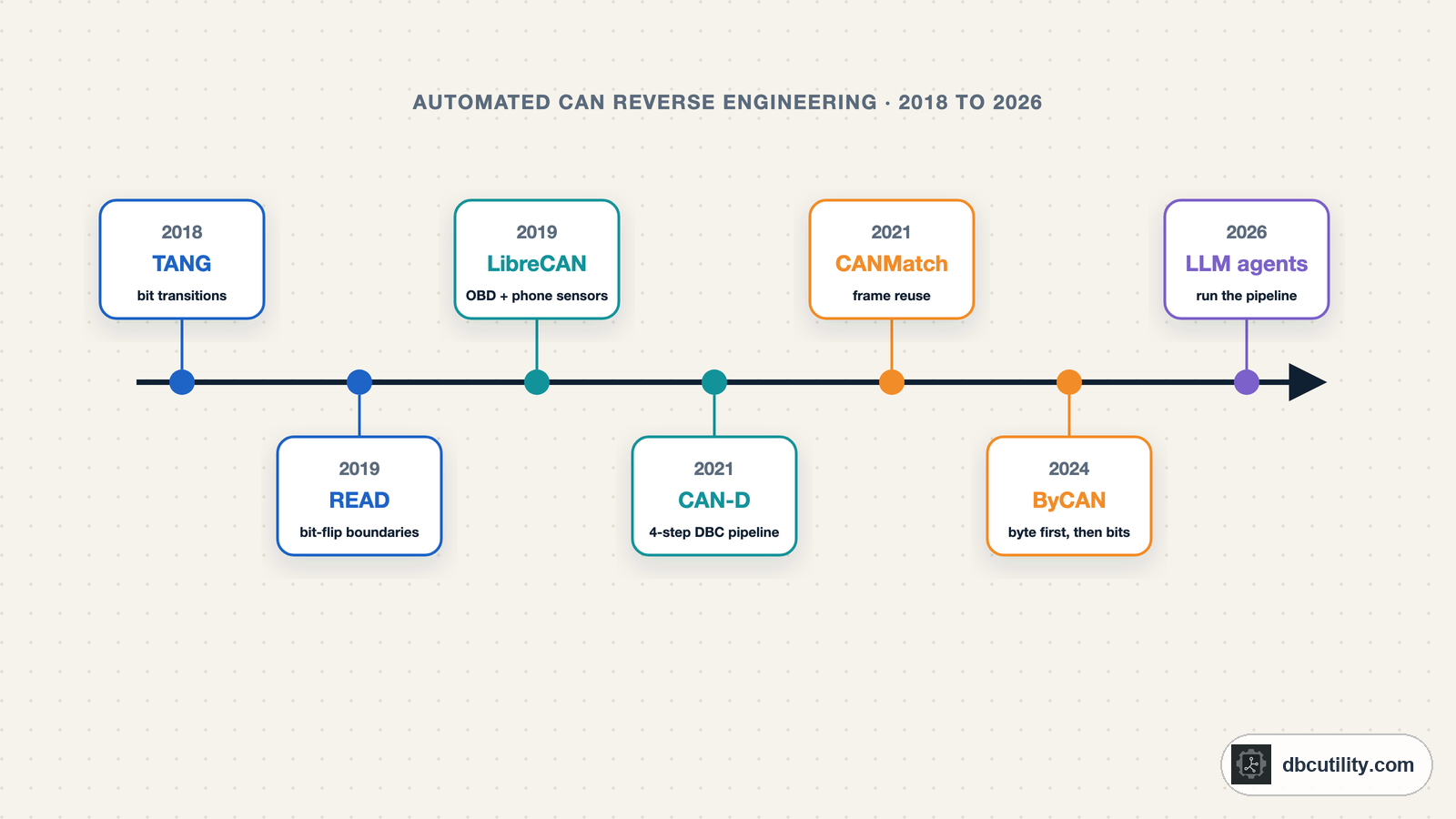
| Method | Published | Core idea | Reported result |
|---|---|---|---|
| Stone, Graham, Mullins | AFIT dissertation 2018; arXiv 1904.03078 | TANG: count how often each bit transitions; bits of one numeric signal have similar patterns | Unsupervised tokenization of real payloads; code published under GPL-3.0 |
| READ | IEEE Transactions on Information Forensics and Security, vol. 14, 2019 | Bit-flip rate per bit; a boundary where the rate drops from one bit to the next | More than twice as many signals as earlier work, about two orders of magnitude faster; validated against a real vehicle's full specification |
| LibreCAN | ACM CCS 2019 | Match candidate signals against OBD-II data and smartphone sensor data; covers body messages too | A relatively complete communication matrix in under two minutes, per the authors' university |
| CAN-D | IEEE Transactions on Vehicular Technology, vol. 70, no. 10, 2021 | Four modular steps; new boundary classifiers and the first signedness classifier; outputs a DBC | Signedness classification F-score above 97 %; average ℓ¹ error 81 % lower than previous methods on 10 vehicles |
| CANMatch | IEEE Transactions on Vehicular Technology, 2021 | Reuse frame IDs and signal definitions already known from other vehicles of the same manufacturer | Evaluated on logs from 479 vehicles from 29 manufacturers |
| Buscemi et al. | 2020 | A data-driven method needing little hardware | Aims to work potentially without physical vehicle access |
| ByCAN | arXiv 2408.09265, 2024 | Cluster bytes first, then refine boundaries at bit level, using DBSCAN on flip rate, value statistics and distinct-value ratio | Better slicing accuracy than READ and CAN-D in the authors' comparison |
| CSS Electronics Claude Code skills | Guide updated June 2026, MIT-licensed code | An LLM agent runs survey, correlation, exhaustive bit search and scale fitting against a reference | A vendor illustration without accuracy figures; some OBD-II PIDs not found |
What each idea is good for
Bit-flip statistics find boundaries
READ's observation is simple and powerful: inside a counting value, the lowest bit flips most often and each higher bit flips less. So a sharp drop in flip rate from one bit to the next marks where one signal ends and the next begins, and a constant bit is padding or unused. Stone's TANG metric uses the same information differently. You can compute flip rates for any log in a few lines; the AI pipeline guide uses them to reject fields whose lowest bit sits in a slow neighbouring signal.
The weakness: signals that rarely change, flags that toggle together, and counters and checksums all confuse pure flip-rate methods. ByCAN's authors report that bit-level methods tend to over-slice, cutting one signal into several, which motivated their byte-first approach.
Real DBCs show what layouts look like
ByCAN studied the DBC files in comma.ai's opendbc repository, which cover 8282 cars from 2001 to 2023, and found that 98.25 % of signals are 16 bits or shorter. Priors like this help: if a search proposes a 23-bit field, it is probably two signals.
Byte order and sign need their own tests
A 16-bit value read in the wrong byte order still changes, so boundary methods alone can return a valid-looking field with the wrong order. CAN-D's contribution was to classify byte order and signedness explicitly, which is why its decoded values matched reality much better than earlier pipelines. In practice: test both orders and both signs, and keep the one that fits a reference best.
Meaning needs a reference
LibreCAN and CAN-D attach meaning by matching extracted signals to diagnostic data whose meaning is standardised, mainly OBD-II PIDs, and LibreCAN adds smartphone sensor data. This only names signals that have a counterpart; door states, lamp commands and most body signals still need controlled stimulus. The CAN reverse-engineering guide covers that manual step.
Known DBCs speed things up
CANMatch exploits the fact that manufacturers reuse frame IDs and signal layouts across models. If you have a DBC for one model, test its definitions on the new log first. Later work from the same group proposed changing ("mutating") traffic between models as a defence against this kind of matching, which says a lot about how well it works.
What LLM agents add
The research methods above are statistics, not language models. What has changed since 2024 is that LLM coding agents can run such pipelines, read the results and propose the next test. The CSS Electronics skills, published as an illustration, follow the same structure as the research: survey bit activity, correlate with a reference, search bit fields exhaustively, fit scale and offset. The vendor reports results on a few vehicles without accuracy metrics, and notes that some signals were not found. A separate 2026 paper, Foundation CAN LM, trains a language model on CAN data that has already been decoded, which is a different problem.
As of November 2026, there is no published benchmark that measures LLM agents against the methods in the table on the same vehicles. Treat an agent as a fast operator of the statistical tools, and score its results the way the research does: against a known DBC, or on held-out data.
How the research evaluates results
Most papers score their output against ground-truth DBCs: the manufacturer's specification where the authors had one (READ), or public DBCs such as opendbc. Common measures are slicing accuracy (did the boundaries match), and the error of decoded values against the true decoding. When you evaluate your own pipeline, do the same: generate or obtain a log with a known DBC, measure, and only then trust it on an unknown vehicle.
What to take into your own work
- Survey flip rates first. Mark constant bits, counters and checksums before anything else.
- Prefer byte-aligned, 16-bit-or-shorter fields unless the data argues otherwise.
- Test byte order and sign explicitly.
- Use every reference you have: OBD-II PIDs, standard J1939 PGNs, GPS, and DBCs of related models.
- Score on held-out data, and report what was not found as clearly as what was.
Frequently asked questions
Can CAN reverse engineering be fully automated?
Signal boundaries, byte order and signedness can largely be recovered automatically from logs. Assigning meaning still needs a reference, such as OBD-II data, sensors or known DBCs, so signals without a counterpart remain unnamed.
What is the READ algorithm?
A method published in 2019 that finds CAN signal boundaries from the bit-flip rate of each payload bit: where the flip rate drops sharply from one bit to the next, one signal ends. It reported finding more than twice as many signals as earlier work, much faster.
What is CAN-D?
A four-step pipeline published in 2021 that recovers signal boundaries, byte order, signedness and physical meaning, and outputs a DBC file. It introduced the first signedness classifier and reported much lower decoding error than earlier methods across 10 vehicles.
Is there open-source code for CAN reverse engineering?
Yes. Stone's pipeline is published under GPL-3.0, the CSS Electronics LLM skills under MIT, and comma.ai's opendbc provides DBCs for many cars to test against. The pipeline in the AI guide on this site uses only the Python standard library.
References
- Marchetti, Stabili: READ (IEEE TIFS 2019)
- Pesé et al.: LibreCAN (ACM CCS 2019)
- Verma et al.: CAN-D (arXiv 2006.05993)
- Buscemi et al.: CANMatch (University of Luxembourg repository)
- Buscemi et al.: a data-driven minimal approach for CAN bus reverse engineering
- Lin et al.: ByCAN (arXiv 2408.09265)
- Stone, Graham, Mullins: unsupervised time series extraction from CAN payloads (arXiv 1904.03078)
- CSS Electronics: AI CAN bus reverse engineering with Claude Code
- Esashi et al.: Foundation CAN LM (arXiv 2602.00866)
DBC Utility
One desktop app for DBC files and CAN recordings.
One-time $34 · Windows & Linux · Files stay on your computer