In short
UN R155 requires a certified cybersecurity management system and a risk assessment for each vehicle type; UN R156 does the same for software updates. ISO/SAE 21434 describes how to do the engineering, centred on the TARA. For in-vehicle networks the result is concrete: authenticated messages, filtering gateways, protected diagnostics and signed software.
Best for: CAN, diagnostics and ECU software engineers whose projects now have cybersecurity requirements, and anyone who needs a clear overview of the regulations
Until a few years ago, cybersecurity in a vehicle project was a good intention. Now it is a type-approval requirement. A vehicle type cannot be approved in the EU, the UK and other markets that apply UN regulations unless its manufacturer can show a certified cybersecurity management system and how it handled the risks of that specific vehicle. That reaches all the way down to individual CAN messages, diagnostic services and software update processes.
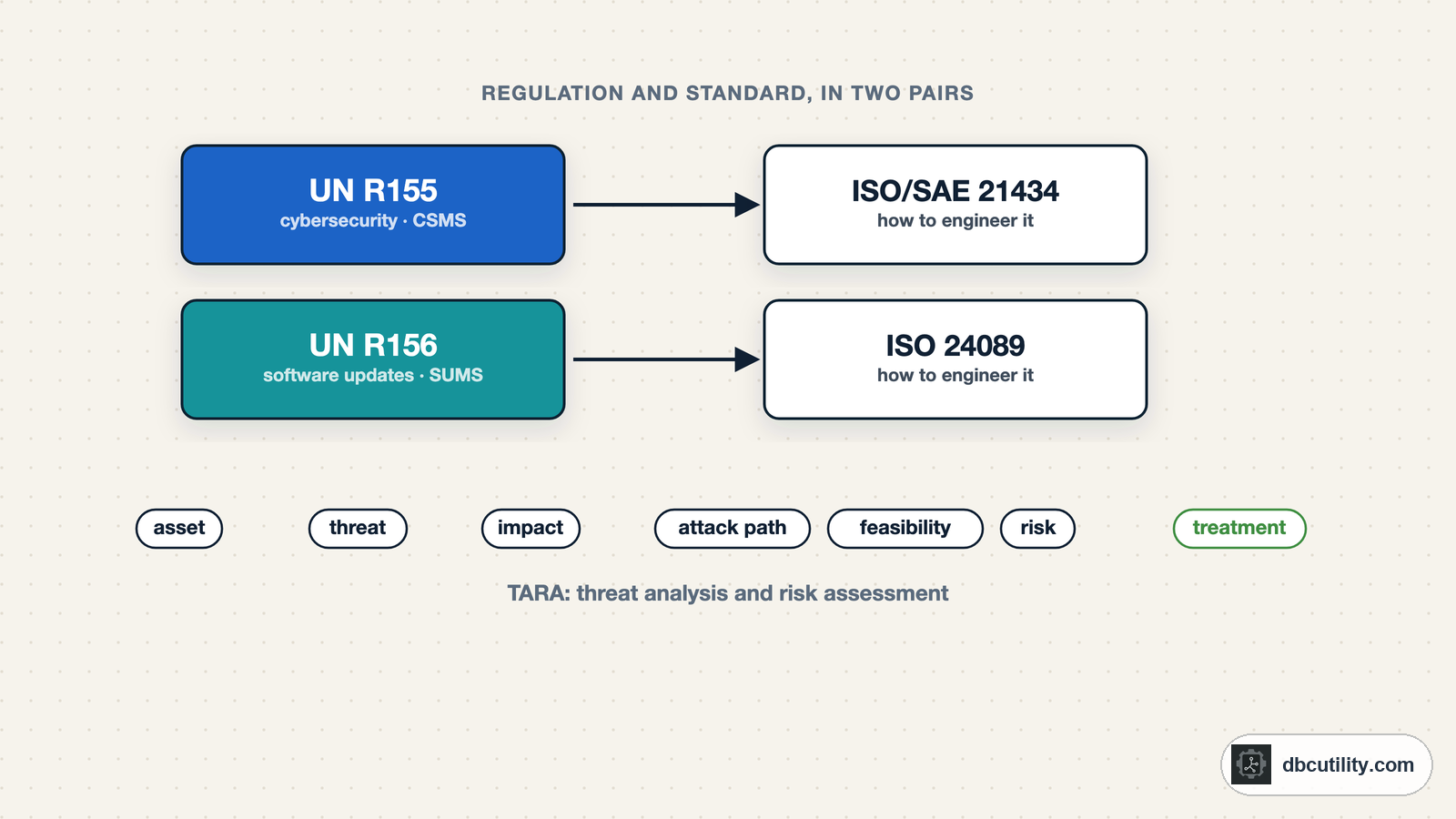
Four documents, two pairs
| Document | What it is | Covers |
|---|---|---|
| UN R155 | UN regulation, part of type approval | Cybersecurity and the cybersecurity management system (CSMS) |
| UN R156 | UN regulation, part of type approval | Software updates and the software update management system (SUMS) |
| ISO/SAE 21434:2021 | International standard | Cybersecurity engineering for road vehicle E/E systems |
| ISO 24089 | International standard | Software update engineering |
The regulations say what must be achieved and are legally binding where they apply. The standards describe how to do the engineering. The UK Vehicle Certification Agency, for example, maps R155 to ISO/SAE 21434 and R156 to ISO 24089. Following the standards is the usual way to show compliance, but it is the regulation that the approval authority audits.
When the regulations apply
UN R155 and R156 came into force at the beginning of 2021. The EU applies them through its vehicle type-approval rules. For cars, vans, trucks and buses in the EU (categories M and N), the UK Vehicle Certification Agency lists these dates for R155:
| From | Applies to |
|---|---|
| 6 July 2022 | New whole-vehicle type approvals |
| 7 July 2024 | Existing type approvals, so in practice every newly registered vehicle |
R156 has dates in steps from 6 July 2022, with later dates for some vehicle categories and for completed vehicles; check the VCA's table for your case. R155's scope covers categories M, N and O (trailers with at least one ECU), and R156 additionally covers agricultural and other categories (T, R, S).
R156 also introduces the RXSWIN, a software identification number for type-approval-relevant software, which the manufacturer must manage through every update.
What R155 asks for
At the organisation level, a CSMS: processes to identify and manage cyber risks across the vehicle's lifecycle, from development through production to the field, including the supply chain, monitoring of attacks and response to new threats. The approval authority certifies it.
At the vehicle-type level, evidence that the manufacturer assessed the risks for that type and mitigated them, that the mitigations were tested, and that the type is monitored after launch. The regulation's annex lists threats and mitigations to consider, which include threats to in-vehicle communication such as spoofing and manipulation of messages.
The TARA, step by step
ISO/SAE 21434 does the risk work in a threat analysis and risk assessment (TARA). Its steps, illustrated with one CAN message:
| Step | Question | Example for a brake request message |
|---|---|---|
| 1. Asset identification | What is worth protecting, and which property: confidentiality, integrity or availability? | Integrity of the brake request on chassis CAN |
| 2. Threat scenario identification | How could that property be violated? | Spoofed brake request frames injected on the bus |
| 3. Impact rating | How bad would it be, for safety, financial, operational and privacy impact? | Severe safety impact: unintended braking |
| 4. Attack path analysis | How could an attacker get there? | Device on the OBD-II port, or a compromised telematics unit through the gateway |
| 5. Attack feasibility rating | How hard is each path? Typically rated by time, expertise, knowledge of the item, window of opportunity and equipment | Depends on whether the port reaches chassis CAN |
| 6. Risk value determination | Combine impact and feasibility | High |
| 7. Risk treatment decision | Avoid, reduce, share or retain the risk | Reduce: authenticate the message and filter at the gateway |
A risk that is reduced becomes a cybersecurity goal and requirements, and those requirements are verified and tested like any other. The informative annexes of the standard include example rating schemes and cybersecurity assurance levels (CAL 1 to 4), which scale the rigour of the work, similar in spirit to ASILs in ISO 26262.
What it changes on the network
The typical treatments of in-vehicle network risks are familiar mechanisms:
| Measure | Against | Guide |
|---|---|---|
| Message authentication with SecOC | Spoofed and replayed messages | SecOC explained |
| Gateways that filter and separate buses | Access from the OBD-II port or external interfaces to safety buses | OBD-II port and secure gateways |
| Authenticated diagnostics | Unauthorised writes, routines, flashing | UDS DID scanning shows what an unprotected ECU reveals |
| Signed software and secure boot | Manipulated firmware | ECU flashing over UDS |
| Intrusion detection and logging | Attacks that get through, monitored in the field |
For engineers working with DBC files and logs, two practical consequences stand out. First, more messages carry authentication bytes, so a DBC needs signals for freshness and MAC fields and tools must not try to decode them as data. Second, test benches and restbus simulations need keys and freshness handling to produce messages an ECU will accept; manage those test keys as carefully as the requirements say, and never mix them with production keys.
How it relates to functional safety
ISO 26262 handles hazards from faults, ISO/SAE 21434 handles threats from attackers, and ISO 21448 handles hazards from functional insufficiencies. They use similar structures, with risk analysis, goals, requirements and verification, and they meet in the same components: an E2E-protected message may also be SecOC-protected, and a safety mechanism such as a timeout can be triggered on purpose by an attacker who floods the bus. Projects coordinate the analyses so that a security measure does not break a safety mechanism and the other way round. The ISO 26262 guide covers the safety side.
Frequently asked questions
What is UN R155?
A UN regulation on vehicle cybersecurity that is part of type approval in markets that apply it, including the EU and UK. It requires a certified cybersecurity management system and, for each vehicle type, evidence that cyber risks were assessed, mitigated, tested and are monitored.
What is the difference between UN R155 and ISO/SAE 21434?
R155 is a legal requirement for type approval: it says what manufacturers must achieve. ISO/SAE 21434 is an engineering standard that describes how to do cybersecurity engineering, including the TARA. Applying ISO/SAE 21434 is a common way to meet R155.
What is a TARA?
Threat analysis and risk assessment. It identifies assets and their security properties, the threats to them, the impact and feasibility of each attack, the resulting risk, and how each risk is treated: avoided, reduced, shared or retained.
What does UN R156 require?
A certified software update management system and controlled, documented software updates, including over the air, with management of the software identification number (RXSWIN) for type-approval-relevant software.
References
DBC Utility
One desktop app for DBC files and CAN recordings.
One-time $34 · Windows & Linux · Files stay on your computer