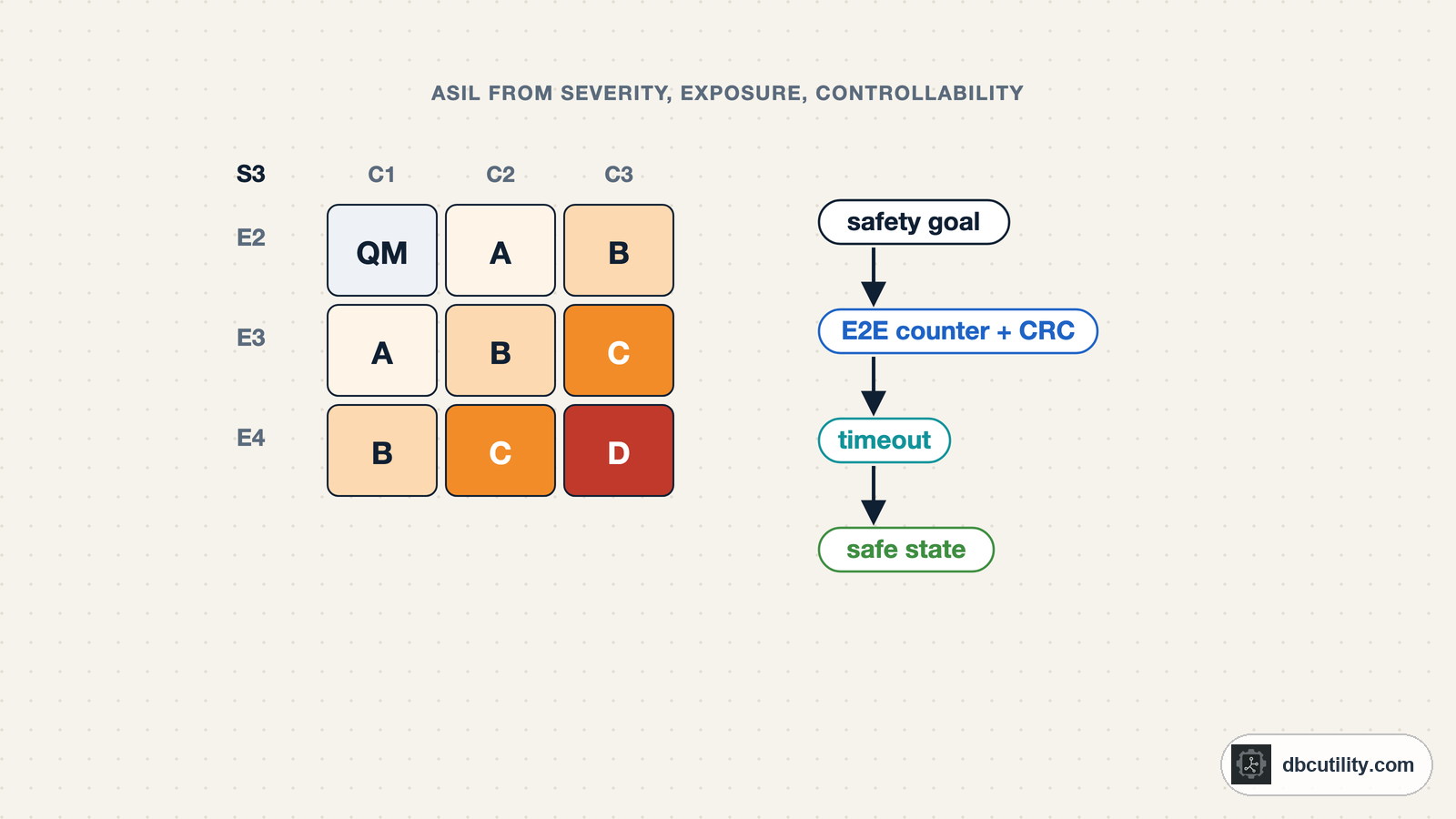
In short
ISO 26262 starts from hazards, rates them with severity, exposure and controllability into an ASIL, and turns safety goals into requirements down to individual messages. For a CAN signal that means detecting corruption, loss, delay and masquerading, typically with E2E protection and timeouts, and defining what the receiver does when the signal is invalid. The rigour of every step grows with the ASIL.
Best for: CAN, embedded and test engineers working on ECUs with safety requirements who need the parts of ISO 26262 that touch their work
ISO 26262 is the functional safety standard for road vehicles. Its 12 parts cover everything from management to semiconductors, and most engineers never read all of them. If you work on CAN messages, ECU software or tests, a few ideas from it shape your daily work: why some messages carry counters and CRCs, why a timeout requirement says "within 100 ms", and why a test report needs traceability. This guide covers those parts.
The standard in one table
The second edition, ISO 26262:2018, extended the first edition of 2011 from passenger cars up to 3.5 t to all road vehicles except mopeds. It has 12 parts:
| Part | Title | Where you meet it |
|---|---|---|
| 1 | Vocabulary | Every term below |
| 2 | Management of functional safety | Safety plans, confirmation reviews |
| 3 | Concept phase | Hazard analysis, ASIL, safety goals |
| 4 | Product development at the system level | System requirements, integration testing |
| 5 | Product development at the hardware level | Hardware metrics |
| 6 | Product development at the software level | Software requirements, design, unit and integration tests |
| 7 | Production, operation, service and decommissioning | Production and service processes |
| 8 | Supporting processes | Requirements management, configuration management, tool qualification |
| 9 | ASIL-oriented and safety-oriented analyses | ASIL decomposition, dependent failure analysis |
| 10 | Guidelines on ISO 26262 | Informative |
| 11 | Guidelines on application to semiconductors | Informative |
| 12 | Adaptation for motorcycles | Motorcycles |
Parts 10 and 11 are guidelines; the others are normative.
From hazard to ASIL
The concept phase analyses what can go wrong at vehicle level, for example "unintended braking at high speed", and rates each hazardous event on three scales:
| Parameter | Classes | Question |
|---|---|---|
| Severity | S0 to S3 | How badly could people be hurt? |
| Exposure | E0 to E4 | How often is the vehicle in a situation where this matters? |
| Controllability | C0 to C3 | Can the driver or others avoid the harm? |
The combination gives the ASIL, from A (lowest) to D (highest), or QM when ordinary quality management is enough. The determination table in ISO 26262-3 follows a simple pattern: ASIL D needs S3, E4 and C3, and each step down in any parameter lowers the ASIL by one. With class 0 in any parameter, the result is QM.
def asil(s, e, c):
    """ASIL from severity (S0-S3), exposure (E0-E4) and controllability (C0-C3)."""
    if 0 in (s, e, c):
        return "QM"
    return {10: "D", 9: "C", 8: "B", 7: "A"}.get(s + e + c, "QM")


print("        " + "  ".join(f"C{c}" for c in (1, 2, 3)))
for s in (1, 2, 3):
    for e in (1, 2, 3, 4):
        print(f"S{s} E{e}   " + "  ".join(f"{asil(s, e, c):>2}" for c in (1, 2, 3)))
Output:
        C1  C2  C3
S1 E1   QM  QM  QM
S1 E2   QM  QM  QM
S1 E3   QM  QM   A
S1 E4   QM   A   B
S2 E1   QM  QM  QM
S2 E2   QM  QM   A
S2 E3   QM   A   B
S2 E4    A   B   C
S3 E1   QM  QM   A
S3 E2   QM   A   B
S3 E3    A   B   C
S3 E4    B   C   D
Each hazardous event gets a safety goal, a top-level safety requirement such as "avoid unintended braking", which inherits the ASIL. Every requirement derived from it, down to software and hardware, carries that ASIL unless it is lowered by ASIL decomposition: splitting a requirement across sufficiently independent, redundant elements, for example two independent sensors, under the constraints in Part 9.
How a safety goal reaches a CAN message
Follow one chain. A brake function's safety goal depends on vehicle speed, which arrives from another ECU over CAN. The derived requirements on that signal look like this:
- The receiver shall detect a corrupted, lost, delayed, repeated or wrongly addressed speed value.
- Detection shall happen within a fault tolerant time, for example within a fixed number of message cycles.
- On detection, the function shall go to a defined safe state, for example use a substitute value, degrade, or switch off with a warning.
Those requirements become concrete mechanisms. AUTOSAR's E2E specification lists which communication faults each of its mechanisms detects:
| Mechanism | Detected communication faults |
|---|---|
| Counter | Repetition, loss, insertion, incorrect sequence, blocking |
| Regular transmission with timeout monitoring | Loss, delay, blocking |
| Data ID with CRC | Masquerade and incorrect addressing, insertion |
| CRC | Corruption, asymmetric information |
So a speed signal with an ASIL typically ends up in a message with an E2E counter and CRC, a cycle time, a receive timeout, and plausibility checks in the receiving software. The CAN controller's own CRC is not enough on its own, because it does not cover gateways or software layers between sender and receiver.
What this means for testing
Safety requirements need evidence that they are met, and the rigour expected rises with the ASIL:
- Requirements-based tests for every safety requirement, traceable in both directions: each requirement to its tests, each test to its requirement.
- Fault injection to show that each communication fault is detected within the fault tolerant time and leads to the safe state. The fault injection guide covers timeouts, frozen counters and wrong CRCs.
- Interface tests that check signal ranges, timing and protection fields against the communication specification.
- Test environments at the right level: model, software, processor or hardware in the loop, as described in the HIL, SIL, MIL and PIL guide.
Tool qualification (Part 8) applies here too. If a tool can introduce or hide an error in a safety-related work product, for example a code generator, a DBC-to-code converter or a test tool that decides pass or fail, the project has to classify it and, depending on the result, qualify it. Keep a record of tool versions and how their output is checked.
Hardware metrics
Part 5 sets targets for how well the hardware's safety mechanisms cover random faults. Two architectural metrics, and a target for the probability of violating a safety goal, are commonly quoted as:
| Metric | ASIL B | ASIL C | ASIL D |
|---|---|---|---|
| Single-point fault metric (SPFM) | ≥ 90 % | ≥ 97 % | ≥ 99 % |
| Latent fault metric (LFM) | ≥ 60 % | ≥ 80 % | ≥ 90 % |
| Probabilistic metric for random hardware failures (PMHF) | < 100 FIT | < 100 FIT | < 10 FIT |
These values are taken from semiconductor vendors' and engineering publications; check them against ISO 26262-5 itself for a safety case.
ISO 26262 and SOTIF
ISO 26262 covers hazards caused by faults: something breaks or is wrong in the design. ISO 21448:2022, SOTIF (safety of the intended functionality), covers hazards that occur although nothing is broken: a camera that misreads a scene, a function used in conditions it was not designed for, or reasonably foreseeable misuse. It applies to E/E systems in series road vehicles and is mostly relevant for sensors and driver assistance. It excludes the faults covered by ISO 26262 and cybersecurity threats, which ISO/SAE 21434 covers; see the ISO/SAE 21434 guide.
Frequently asked questions
What is an ASIL?
Automotive Safety Integrity Level: a rating from A (lowest) to D (highest) of the risk reduction needed for a hazard, based on its severity, exposure and controllability. QM means no safety requirement beyond normal quality management.
How is the ASIL determined?
Each hazardous event is classified for severity (S0 to S3), exposure (E0 to E4) and controllability (C0 to C3). S3, E4 and C3 give ASIL D; each step down in any parameter lowers it by one level; class 0 in any parameter gives QM.
Why do safety-relevant CAN messages need E2E protection?
The CAN CRC only protects one transmission on one bus. ISO 26262 requires the receiving function to detect corruption, loss, delay, repetition and masquerading of the data it depends on, wherever they happen. E2E counters, CRCs with Data IDs and timeouts provide that detection end to end.
What is the difference between ISO 26262 and SOTIF?
ISO 26262 addresses hazards from faults in electrical and electronic systems. SOTIF, ISO 21448, addresses hazards from functional insufficiencies and foreseeable misuse when nothing is faulty, such as a sensor that misinterprets a scene.
References
DBC Utility
One desktop app for DBC files and CAN recordings.
One-time $34 · Windows & Linux · Files stay on your computer