In short
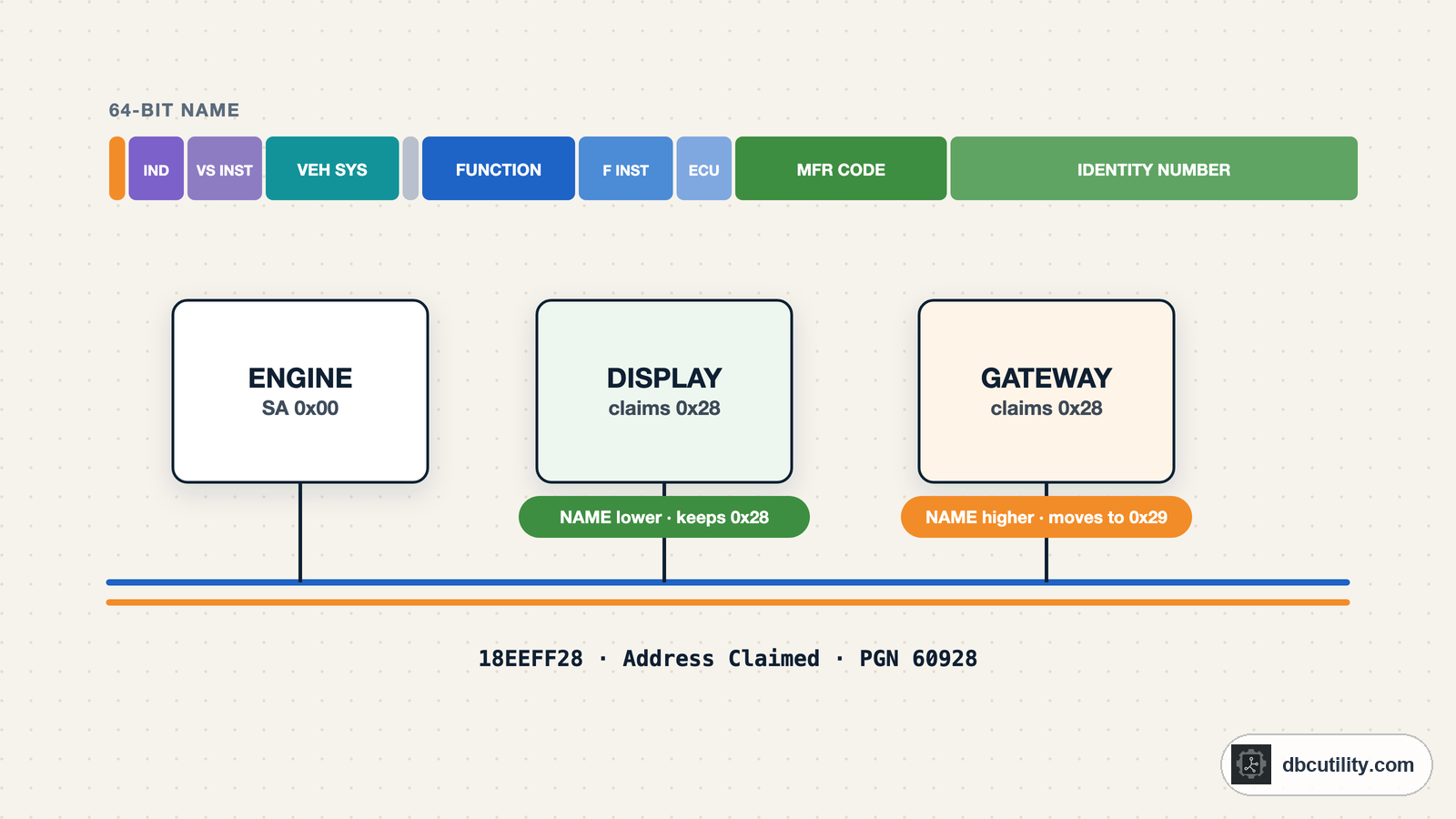
Every J1939 ECU has a unique 64-bit NAME and claims a one-byte source address with PGN 60928. If two ECUs claim the same address, the one with the lower NAME keeps it, and the other moves or goes silent.
Best for: Engineers adding a device to a J1939 network, or debugging address conflicts and missing ECUs
Every J1939 frame ends with a one-byte source address: 00 for the engine, 03 for the transmission, and so on. Those addresses are not wired into the bus. Each ECU has to claim one when it starts, and two ECUs must never use the same one. SAE J1939-81 defines how, and you need to know it the moment you add a logger, a display, or a test tool that transmits.
The Address Claimed message
An ECU claims an address by sending Address Claimed, PGN 60928 (0xEE00), from the address it wants, to everyone:
18EEFF00 [8] 40 E2 61 24 00 00 00 9018is priority 6.EEis the PDU Format of PGN 60928.FFis the destination: all ECUs.00is the address being claimed.
The 8 data bytes are the ECU's NAME, a 64-bit number that is unique on the network.
After it sends the claim, the ECU waits about 250 ms for objections before it relies on the address.
The 64-bit NAME
The NAME describes what the device is and who made it. It is sent low byte first:
| Bits | Field | Size | Meaning |
|---|---|---|---|
| 0–20 | Identity number | 21 bits | Unique number set by the manufacturer, often a serial number |
| 21–31 | Manufacturer code | 11 bits | Assigned by SAE to each manufacturer |
| 32–34 | ECU instance | 3 bits | Which ECU, when one function uses several |
| 35–39 | Function instance | 5 bits | Which instance of the same function |
| 40–47 | Function | 8 bits | What the device does, such as engine or transmission |
| 48 | Reserved | 1 bit | |
| 49–55 | Vehicle system | 7 bits | The system the device belongs to |
| 56–59 | Vehicle system instance | 4 bits | Which instance of that system |
| 60–62 | Industry group | 3 bits | 0 global, 1 on-highway, 2 agriculture and forestry, 3 construction, 4 marine, 5 industrial |
| 63 | Arbitrary address capable | 1 bit | 1 if the ECU can pick another address by itself |
Decoding the example bytes 40 E2 61 24 00 00 00 90:
def decode_name(data: bytes) -> dict:
    name = int.from_bytes(data[:8], "little")
    return {
        "identity_number": name & 0x1FFFFF,
        "manufacturer_code": (name >> 21) & 0x7FF,
        "ecu_instance": (name >> 32) & 0x7,
        "function_instance": (name >> 35) & 0x1F,
        "function": (name >> 40) & 0xFF,
        "vehicle_system": (name >> 49) & 0x7F,
        "vehicle_system_instance": (name >> 56) & 0xF,
        "industry_group": (name >> 60) & 0x7,
        "arbitrary_address_capable": bool(name >> 63),
    }


print(decode_name(bytes.fromhex("40E2612400000090"))){'identity_number': 123456, 'manufacturer_code': 291, 'ecu_instance': 0,
'function_instance': 0, 'function': 0, 'vehicle_system': 0,
'vehicle_system_instance': 0, 'industry_group': 1,
'arbitrary_address_capable': True}So this is an on-highway device (industry group 1), identity number 123456, that can move to another address if it has to.
Many forum threads get the bit numbering wrong. Treat the 8 bytes as one little-endian 64-bit integer, as above, and the fields fall out cleanly.
When two ECUs want the same address
Suppose a display and a gateway both claim address 0x28:
18EEFF28  [8]  <NAME of display>
18EEFF28  [8]  <NAME of gateway>
Each ECU compares the other NAME with its own as a 64-bit number. The lower NAME wins and keeps the address. The loser then does one of two things:
- If it is arbitrary address capable (bit 63 = 1), it claims a different free address.
- If it is not, it sends a Cannot Claim Address message: the same PGN 60928, but from the null address
0xFE. Then it stops sending normal messages.
18EEFFFE [8] <NAME of loser> Cannot Claim AddressBecause bit 63 is the highest bit of the NAME, an arbitrary-address-capable device has a higher NAME, and so loses to an otherwise identical device with a fixed address.
Finding out who is on the bus
Any ECU can ask every other ECU to repeat its claim. It sends the Request PGN 59904 (0xEA00) with the PGN it wants, 60928, in the data:
cansend can0 18EAFFFE#00EE00EAis the Request PGN,FFasks everyone, andFEis the null address. A device may send this request before it has claimed an address.00 EE 00is PGN 60928, low byte first.
Every ECU answers with its Address Claimed message, so a short candump afterwards lists all the addresses in use and the NAME behind each one:
candump -L can0,00EE0000:00FF0000The filter keeps frames whose PDU Format is EE.
Only do this on a bus you are allowed to transmit on. The request is harmless, but anything you send reaches every ECU.
Address claiming on Linux
Since Linux 5.4, the kernel has a J1939 stack with CAN_J1939 sockets. It handles address claiming and the transport protocol for your application.
The can-utils package includes j1939acd, an address claim daemon that claims and defends an address for a NAME. This example, from the kernel developers' own test notes, gives it a set of candidate addresses with -r and the NAME 1122334455667788:
j1939acd -r 100,80-120 1122334455667788 vcan0On a virtual vcan0 bus, you can run it next to candump vcan0 and watch the Address Claimed frames appear. For Python, the can-j1939 package implements address claiming on top of python-can.
Common problems
- A new device makes another ECU disappear. Both claimed the same address and your device had the lower NAME. Give your device a fixed address that is not used on that vehicle, or make it arbitrary address capable with a higher NAME.
- Your tool sends but nothing answers. It never claimed an address, or it lost the claim and went quiet. Check for Cannot Claim Address frames from
FE. - Addresses change between power cycles. Arbitrary-address-capable ECUs can end up with different addresses each start. Identify devices by NAME, not by address.
- NAME fields look random. You decoded the bytes big-endian. NAME is little-endian.
Frequently asked questions
What is PGN 60928 in J1939?
It is Address Claimed. An ECU sends it from the address it wants, with its 64-bit NAME as data, to claim that address on the network.
What happens if two J1939 devices use the same address?
The one with the lower NAME keeps it. The other moves to another address if it is arbitrary address capable, or sends Cannot Claim Address from address 254 and stops transmitting.
What does address 254 mean in J1939?
254 (0xFE) is the null address. An ECU that has no valid address uses it for Cannot Claim Address messages and for requests sent before it has claimed one.
References
DBC Utility
One desktop app for DBC files and CAN recordings.
One-time $34 · Windows & Linux · Files stay on your computer