In short
AUTOSAR is a standard software architecture for car ECUs. Classic AUTOSAR layers application code, a runtime environment, and basic software over the microcontroller, and CAN lives in the basic software. Adaptive AUTOSAR runs service-based applications on high-performance computers.
Best for: CAN, test, and integration engineers who work with AUTOSAR ECUs, ARXML files, or DBC files generated from AUTOSAR projects
If you work on CAN networks in a modern car, sooner or later you receive an ARXML file instead of a DBC, or a supplier says a message is "configured in COM". That is AUTOSAR. You do not need to write AUTOSAR software to work around it, but you need to know how it is built and where the CAN data comes from.
AUTOSAR in one paragraph
AUTOSAR (AUTomotive Open System ARchitecture) is a standard software architecture for vehicle ECUs, developed since 2003 by a partnership of carmakers, suppliers, and tool vendors. It defines how ECU software is layered, how the layers talk to each other, and how the whole thing is described in XML files called ARXML. The aim is that the same application software can run on different hardware, and that software from different suppliers fits together.
There are two platforms:
| Classic Platform | Adaptive Platform | |
|---|---|---|
| Runs on | Microcontrollers in most ECUs | High-performance computers for driver assistance, infotainment, central compute |
| Language | C | C++ |
| Operating system | AUTOSAR OS, a static real-time OS | A POSIX operating system such as Linux or QNX |
| Configuration | Fixed at build time | Applications can be deployed and updated more flexibly |
| Communication | Signals on CAN, LIN, FlexRay, Ethernet | Services, mostly over Ethernet |
Most CAN traffic in a car comes from Classic Platform ECUs. The two platforms are used side by side, not as replacements.
The Classic Platform layers
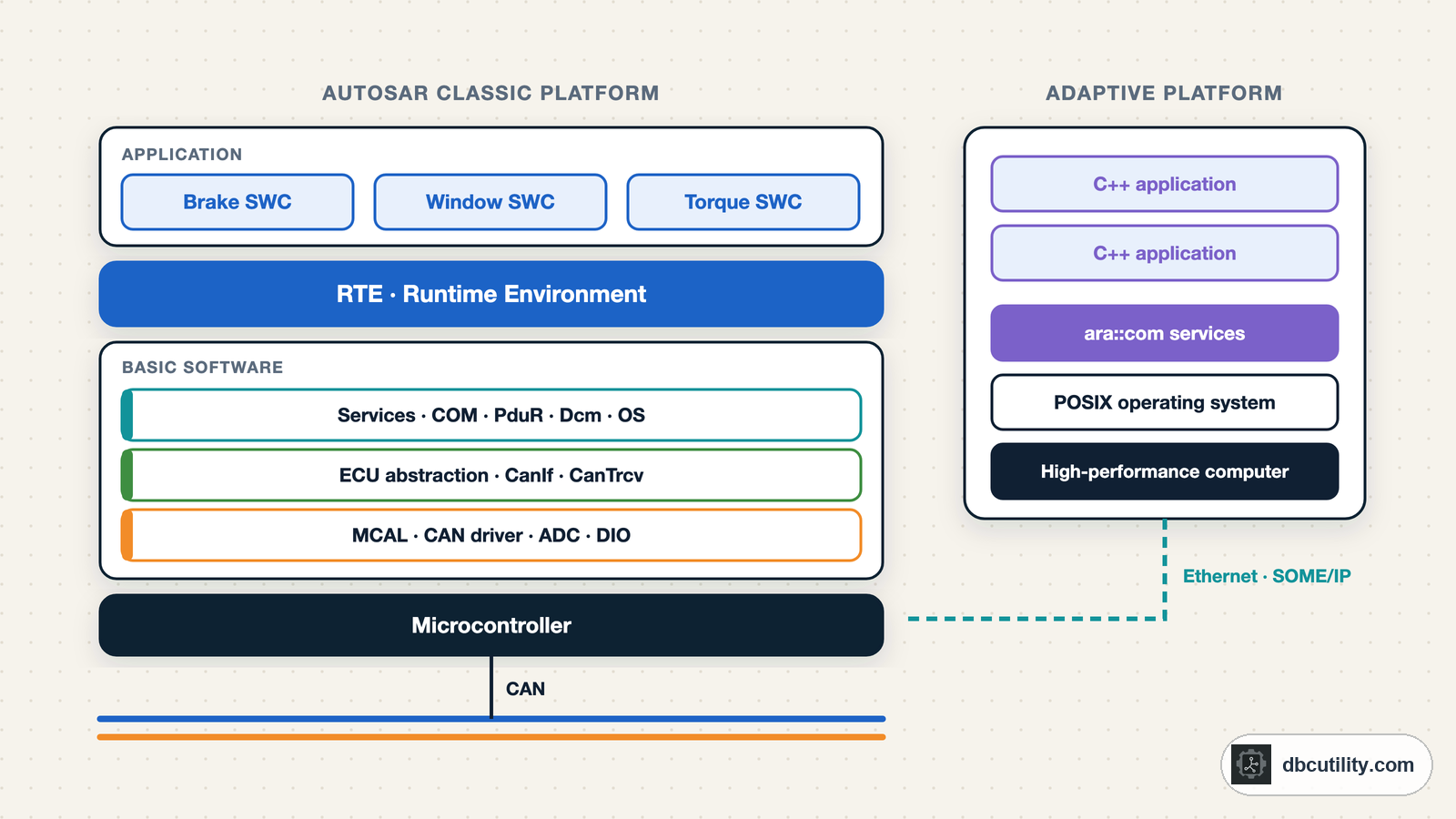
A Classic AUTOSAR ECU is built in layers:
+-------------------------------------------------------+
|  Application layer: software components (SWCs)        |
+-------------------------------------------------------+
|  RTE: Runtime Environment                             |
+-------------------------------------------------------+
|  Basic software (BSW)                                 |
|    Services layer      (COM, diagnostics, memory...)  |
|    ECU abstraction     (CanIf, transceiver drivers)   |
|    MCAL                (CAN, ADC, DIO drivers...)     |
+-------------------------------------------------------+
|  Microcontroller                                      |
+-------------------------------------------------------+
Application layer. The vehicle functions, such as window control or engine torque, are written as software components (SWCs). An SWC never touches hardware or CAN directly. It reads and writes values through ports.
RTE (Runtime Environment). The RTE connects SWC ports to each other and to the basic software. It is generated for each ECU. When an SWC writes a value to a port, the RTE either delivers it to another SWC on the same ECU or hands it to the communication stack to go out on the bus.
Basic software (BSW). Standard modules that every ECU needs. It is split into:
- Services layer: communication (COM, PduR), diagnostics (Dcm, Dem), memory, mode management, and the OS.
- ECU abstraction layer: hides the board, for example which transceiver is fitted. The CAN interface (CanIf) sits here.
- MCAL (Microcontroller Abstraction Layer): drivers for the chip's peripherals, including the CAN controller.
Complex device drivers sit beside the layers for hardware that needs special timing or does not fit the standard modules.
Where CAN fits
CAN is handled entirely in the basic software. A signal written by an SWC goes down through COM (which packs it into a PDU), the PDU router, the CAN interface, and the CAN driver before it reaches the bus. Received frames go the other way. The AUTOSAR CAN stack guide walks through each module.
For a CAN engineer, the important point is that the frames on the bus are generated from configuration. Message IDs, signal positions, cycle times, and timeouts all come from ARXML, not from hand-written code.
ARXML: the description files
Everything in an AUTOSAR project is described in ARXML, an XML format:
- System description: all ECUs, buses, frames, PDUs, and signals in a vehicle network.
- ECU extract: the part of the system description that concerns one ECU.
- ECU configuration: the settings of every basic software module on that ECU.
- Software component descriptions: the SWCs, their ports, and data types.
Tools read these files and generate the RTE and basic software configuration code. That is why changing a CAN signal in an AUTOSAR project means changing ARXML and regenerating, not editing C.
For network and test teams, a DBC file is usually generated from the system description, one per CAN bus, because loggers and analysis tools read DBC. The ARXML and DBC guide covers what to check after that conversion.
The Adaptive Platform
The Adaptive Platform is for high-performance computers that run many applications, receive software updates often, and talk over Ethernet.
- Applications are C++ processes on a POSIX operating system.
- Communication is service-oriented: an application offers or uses services through an API called
ara::com, typically carried over SOME/IP on Ethernet. - There is no RTE in the Classic sense; the Adaptive runtime (ARA) provides communication, execution, and other functions.
Adaptive ECUs rarely sit directly on CAN. CAN data usually reaches them through a gateway or zone controller that runs the Classic Platform.
AUTOSAR releases
AUTOSAR publishes new releases regularly. Older releases were numbered like R4.4.0; since 2019 they are named by year and month, such as R19-11, R22-11, and R25-11. Projects pick one release and stay on it, so two ECUs in the same car can use different releases.
What this means for your CAN work
- The source of truth is ARXML. If a signal is wrong on the bus, the fix usually belongs in the ARXML, not in the DBC.
- DBCs are exports. Keep track of which ARXML version a DBC was generated from, and compare each new export with the last one.
- Some protocol details are AUTOSAR features, such as update bits, I-PDU multiplexing, end-to-end protection counters and CRCs, and secure onboard communication. They appear as extra signals or bytes in the DBC.
- Timeouts and default values are configured in COM, so an ECU may replace a missing signal with a default value instead of failing.
Frequently asked questions
What is the difference between AUTOSAR Classic and Adaptive?
Classic runs on microcontrollers with a static real-time OS and C code, and communicates with signals over CAN, LIN, FlexRay, and Ethernet. Adaptive runs C++ applications on high-performance computers with a POSIX OS and communicates with services, mostly over Ethernet.
Is AUTOSAR an operating system?
No. AUTOSAR is an architecture and a set of specifications. The Classic Platform includes an OS specification (AUTOSAR OS), and the Adaptive Platform runs on a POSIX operating system, but AUTOSAR as a whole covers much more than the OS.
Does AUTOSAR replace DBC files?
Not in practice. AUTOSAR projects describe networks in ARXML, but loggers, analysers, and test tools still mostly read DBC, so DBC files are generated from the ARXML for each CAN bus.
References
DBC Utility
One desktop app for DBC files and CAN recordings.
One-time $34 · Windows & Linux · Files stay on your computer