UDS in simple words
UDS is a standard way for a diagnostic tester to ask an ECU for information or request a diagnostic action.
UDS stands for Unified Diagnostic Services. The main protocol is defined by ISO 14229.
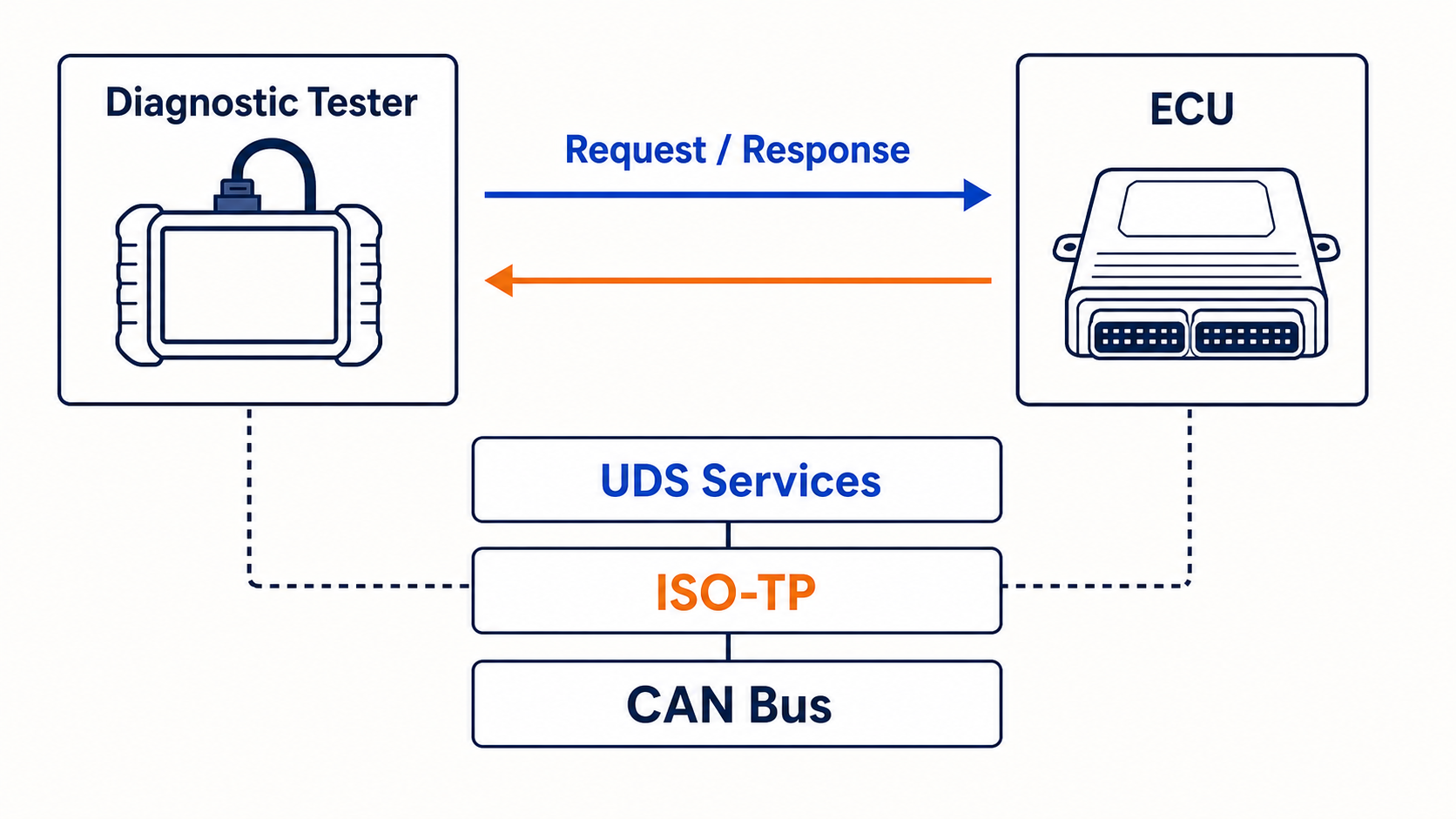
A tester sends a request. The ECU sends a positive response, a negative response, or no response if communication fails.
Tester -> UDS request -> ECU
Tester <- UDS response <- ECU
What UDS is used for
UDS supports services for work such as:
- changing diagnostic sessions
- reading ECU data
- writing allowed ECU data
- reading diagnostic trouble codes
- clearing diagnostic information
- running ECU routines
- controlling communication
- security access
- software download and programming
- resetting an ECU
Not every ECU supports every service. Supported services, data identifiers, routines, sessions, and access rules are defined by the project.
UDS over CAN
UDS messages can be larger than one classical CAN frame. On CAN, UDS commonly uses ISO-TP, defined by ISO 15765-2, to split and reassemble longer messages.
The layers are:
UDS       -> diagnostic service and data
ISO-TP    -> moves long diagnostic payloads over CAN frames
CAN       -> sends the actual frames on the bus
UDS can also run on other transports, such as Diagnostics over IP. Do not assume UDS always means raw CAN frames.
Service IDs
Each UDS request begins with a service identifier, often called SID.
Common examples include:
| SID | Service |
|---|---|
0x10 | Diagnostic Session Control |
0x11 | ECU Reset |
0x14 | Clear Diagnostic Information |
0x19 | Read DTC Information |
0x22 | Read Data By Identifier |
0x27 | Security Access |
0x2E | Write Data By Identifier |
0x31 | Routine Control |
0x34 | Request Download |
0x36 | Transfer Data |
0x3E | Tester Present |
A positive response SID is commonly the request SID plus 0x40.
Request:  0x22 Read Data By Identifier
Response: 0x62 Positive Read Data By Identifier response
DID meaning
DID stands for Data Identifier. A DID identifies a piece of ECU data.
For example, DID 0xF190 is commonly used for the Vehicle Identification Number.
A request may look like:
22 F1 90The positive response begins with:
62 F1 90 ...data...OEM and supplier projects define many additional DIDs. You need the correct diagnostic specification to know their sizes, encodings, and access conditions.
Diagnostic sessions
An ECU can expose different functions in different sessions.
Common session ideas are:
- default session
- programming session
- extended diagnostic session
A service that works in the extended session may be rejected in the default session. Sessions also have timing and inactivity behavior. Tester Present messages may be needed to keep a non-default session active.
Positive and negative responses
A positive response means the ECU accepted and completed the request.
A negative response begins with 0x7F:
7F <request SID> <negative response code>Example:
7F 22 31This means the ECU rejected service 0x22 with negative response code 0x31, Request Out Of Range.
Other common reasons include:
- service not supported
- sub-function not supported
- incorrect message length
- conditions not correct
- security access denied
- request sequence error
- response pending
A good tester reports the code clearly instead of only showing “request failed.”
Security Access
Some UDS functions are protected. The tester may request a seed and return a calculated key.
Security Access is not permission to bypass an ECU's protection. The algorithm and access process belong to the vehicle or ECU program. Use only approved credentials and test procedures.
Modern systems may also use additional authentication and secure diagnostic mechanisms.
DTC meaning
DTC stands for Diagnostic Trouble Code. An ECU records DTC information when monitored conditions fail.
UDS services can request information such as:
- which DTCs are stored
- current status bits
- snapshot data
- extended data
- supported DTC information
The exact behavior depends on the ECU implementation and diagnostic specification.
UDS request example
Read DID 0xF190:
Application request: 22 F1 90When carried as a short ISO-TP single frame on CAN, it may look like:
03 22 F1 90 00 00 00 00The first byte says three UDS bytes follow. A longer VIN response needs ISO-TP multi-frame handling.
Use an ISO-TP library. Do not treat the first CAN frame as the complete UDS response.
UDS vs OBD-II
| UDS | OBD-II |
|---|---|
| Broad ECU diagnostic protocol | Standardized emissions-related diagnostics |
| Project-specific DIDs and routines | Standard modes and PIDs for regulated data |
| Used for development, service, manufacturing, and programming | Commonly used by generic scan tools for emissions data |
| Can support ECU flashing | Focused on diagnostic and emissions information |
Some vehicles support both.
The simple summary
UDS is a request-response protocol for ECU diagnostics. Services identify the action, DIDs identify data, sessions control access, and negative response codes explain why a request was rejected. Over CAN, ISO-TP carries UDS messages that do not fit in one frame.